Interoperability: an introductory course
Notes from the introductory course on Interoperability.
These are notes from the course “Interoperability: an introductory course” which can be found on this page of the EU Academy.
Interoperability is the ability of organizations to interact with each other across systems and processes to achieve common goals. It involves the sharing of information and knowledge through the business processes by mean of exchange of data between ICT systems.
The concept of interoperability is not new: the internet protocol is the most important building block. The main needs for interoperability is:
- reducing administrative burden for European Union citizens when traveling or relocating to another European Union country.
- acceding to public services involving multiple governmental agencies, as well as actors from the private sector.
Even though the results of interoperability are obvious when achieved, the path is complex and requires:
- amendments of existing legislation to facilitate interoperable service provision
- coordination and business process alignment among different competent authorities that must contribute to the implementation of the service
- restrictions that derive from the legacy information systems that are involved in the service provision
European Union’s position towards interoperability
As part of the Digital Decade Strategy, the European Commission is helping the Public Administrations across Europe to access digitally all public services to all European Union citizens and businesses by 2030. The focus is on reducing the barriers between the different public services, ensuring accessibility throughout sectors and borders. Such digital transformation plan is not only ambitious but also complex and interoperability is key in tackling such barriers by:
- Minimizing administrative burden
- Reducing cost, time and delivery for Public Administration, citizens and businesses
- Facilitating re-use of digital tools
- Improving security of digital tools
- Improving decision making through data sharing
- Fostering innovation through direct impact on development and competitiveness of Europe
- Accelerating achievement of strategic objectives and implementation of public policies, protecting both public interest and citizens rights
Services constitute a large part of the European Union economy. Freedom to provide services cross-border is assured by common policies supported by interconnected and interoperable network and systems. As European Union citizens are free to travel and relocate across different European Union countries than their home one, they interact with multiple public administrations. Regulations required by every Member State to set up a services company are managed by EUGO, a network of national coordinators from European Union Member States.
Thanks to the IT tools (developed by the European Commission) for the validation of digital signature, the documents can be digitally signed, allowing online authenticity and verification. Here below are some examples that require interoperability to function:
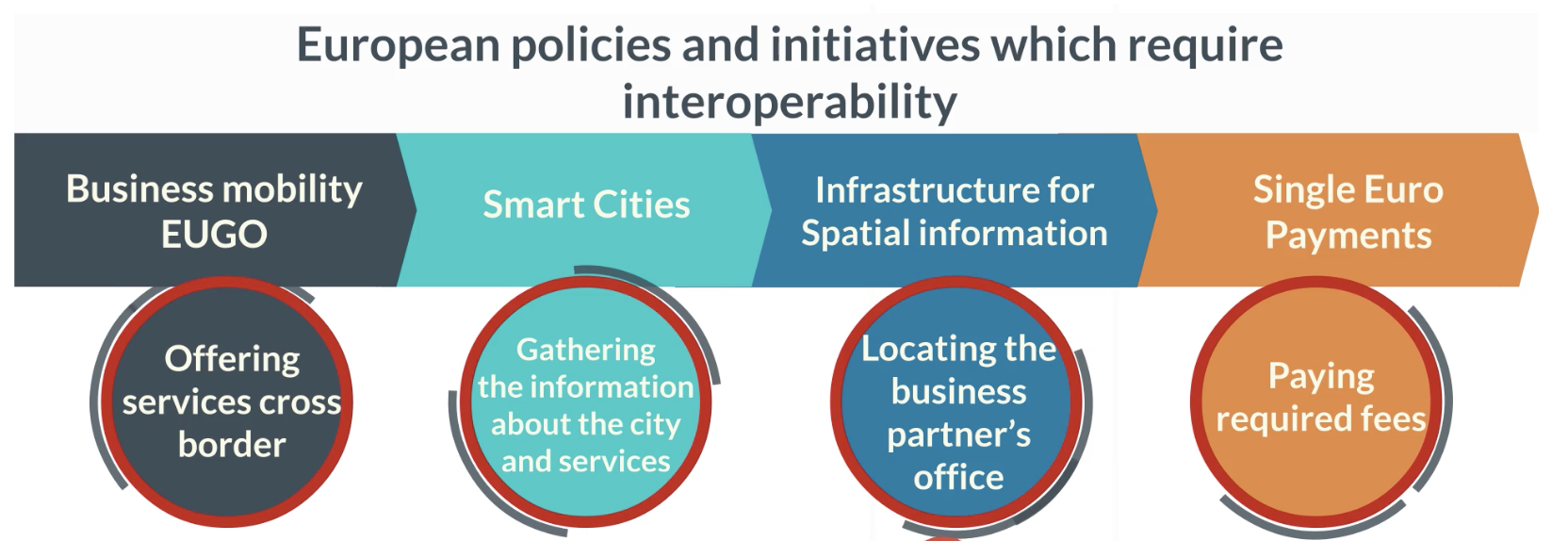
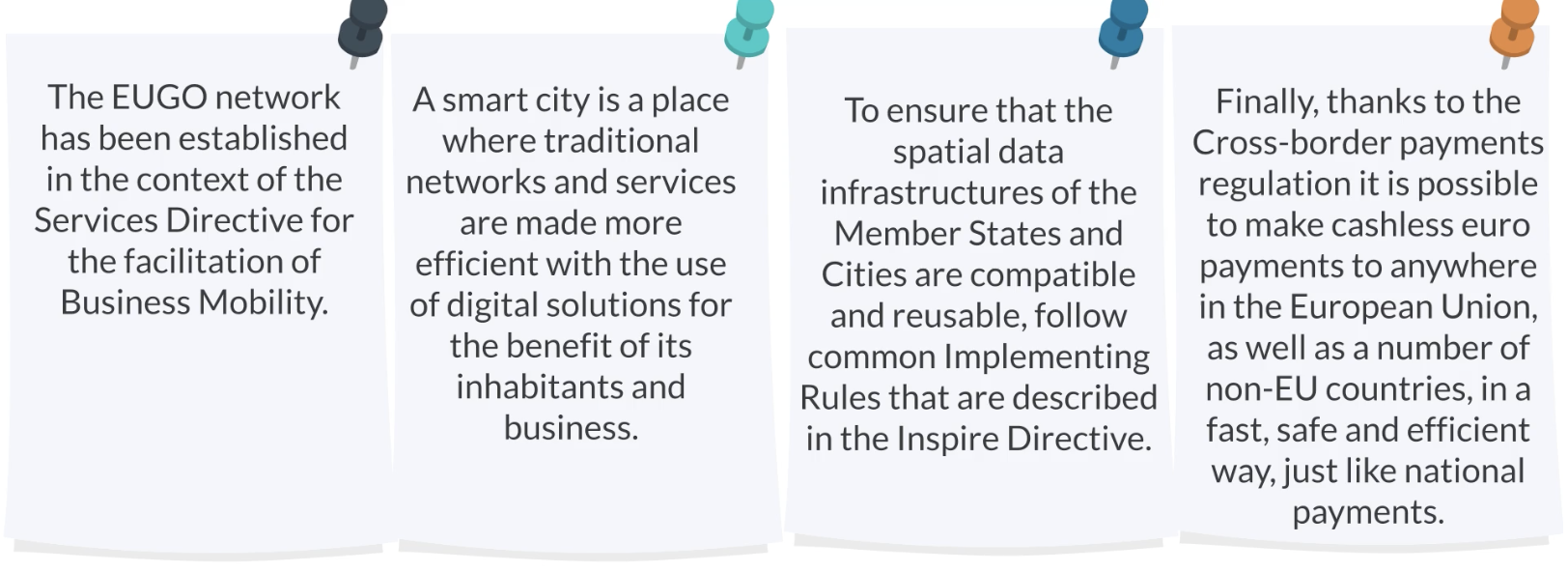
Case study: automated social energy tariff developed in Portugal
In 2016, Portugal developed an automated social energy tariff, which aimed to grant social benefit to low-income families, without even asking for it. The tariff is an example of interoperability across sectors (public and private), and across government services at the benefit of citizens, ultimately ensuring equal treatment in front of the law.
The Portuguese Interoperability Platform allowed the following data to be shared across actors from different sectors and government services, through open standards:
- Income data from tax authority
- Contracts information from energy supplier
- Benefits data from the social security institution
Achieving such benefits required major updates in regulations:
- First, the required exchange of data and business rules are established among the actors for the provision of the service
- Exchanged datasets are kept to a minimum for privacy reasons: instead of sharing sensible citizen data, only a data confirming eligibility of the service is shared (e.g. “does citizen John Doe is eligible to this benefit?”)
- Ultimately the required data is transferred to energy supplier that generates the energy bills for the citizens, including them either in the social energy tariff of regular tariff.
Lessons learnt
- New interoperable public services require a specific legal framework for the allocation of responsibilities among the involved stakeholders, the operation details and obligations.
- Interoperability allow public administration to be proactive, reducing citizens administrative burden.
- Interoperable services require strong coordination, interoperability agreements among the involved stakeholders with a clear definition regarding the tasks that each one implements and contributes.
- Interoperability platforms accelerate the implementation of new public services, reusing existing solutions, components and information.
- Standardisation is crucial at process level, for data definition and at technical level for the provision of interoperable services.
- Involving political stakeholders is crucial for the support required for the implementation of a new service.
Where to find useful resources?
Some questions like “How to protect citizens data? How to find and create a semantic standard for data unification?” can be answered through answers found on the Interoperable Platform website. The services available through the Interoperable Platform respect the following standards (established by European Union law):
- Lawfulness: data is used only for the indicated service (unless agreed differently by the user).
- Fairness: data is minimal and necessary for services creation.
- Transparency: data is protected.
Other important tools that can be found on the Interoperable Platform website are:
- NIFO (National Interoperability Framework Observatory) is a monitoring tool to track the progress of the interoperability implementation at national level for each Member State. It contains the latest developments on digital public administration and interoperability across Europe.
- OSOR (Open Source Observatory) is a multifunctional platform where users can find relevant open source software solutions, read about the use of free and open source, public news and find out about events.
- Building blocks: while they are not addressed the end user, they are important reusable solutions, like eInvoicing and eIdentification. They are built upon the Once-Only principle, which is a base of interoperable solutions, crucial to establish the Single Digital Gateway.